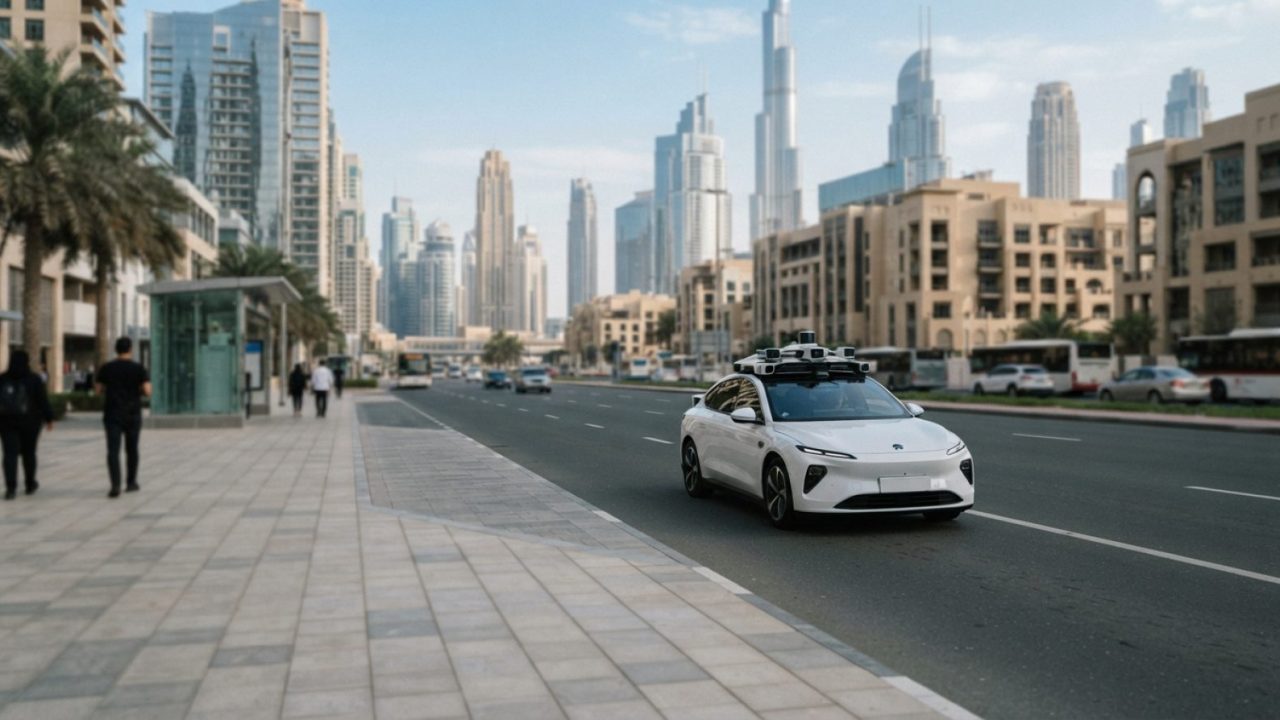
Chinese search and artificial intelligence company Baidu has expanded testing and commercial operations of its autonomous driving taxi platform, Apollo Go, across 24 Chinese cities and four international locations, including Abu Dhabi, Dubai, London, and Switzerland, according to a report by Maeil Business Newspaper.
Apollo Go currently operates with Level 4 autonomous driving capability and can drive fully driverless in designated zones. Baidu reported that the cumulative autonomous driving distance of the platform has surpassed 350 million kilometers, of which more than 240 million kilometers were completed without a safety driver, setting a global record for fully driverless testing distance.
According to the source, an Apollo Go vehicle costs approximately 250,000 yuan (around 50 million Korean won), which is about one-third the cost of competing autonomous vehicles operated by US-based Waymo. Baidu localized LiDAR sensors beginning with its second-generation vehicle and holds at least 5,900 related patents, though it still utilizes NVIDIA chipsets. Its sixth-generation vehicle delivers an operating range of up to 380 kilometers per charge and supports a three-minute automated battery swap, with a seventh-generation model scheduled to launch in late 2026 or 2027.
The deployment is part of a broader wave of Chinese high-tech firms advancing physical AI from Beijing's Zhongguancun and Yizhuang development hubs, where over 2,500 AI companies are clustered. Alongside Baidu, robotics unicorn GALBOT has developed embodied robot intelligence for logistics and distribution environments, ByteDance is expanding into AI video and workflow platforms, and iFLYTEK is advancing voice-recognition systems.
Sources
- 매일경제 · 2026-10-21