- Issuing authority
- UAE Ministry of Finance
- Jurisdiction
- United Arab Emirates
- Effective date
- October 30, 2026
- Stage
- Amendment
- Official document
- Ministerial Resolution No. 66 of 2026 amending Ministerial Decision No. 244 of 2025
- Official source
- dddinvoices.com

On October 22, 2026, Liu Haixing, Minister of the International Department of the Central Committee of the CPC, met with an official UAE leadership delegation in Beijing. According to the UAE-China Chamber of Commerce, discussions centered on policy coordination between China's upcoming 15th Five-Year Plan and the 'We the UAE 2031' strategic vision, focusing on expanding bilateral trade flows, technology investments, and industrial supply chain partnerships.
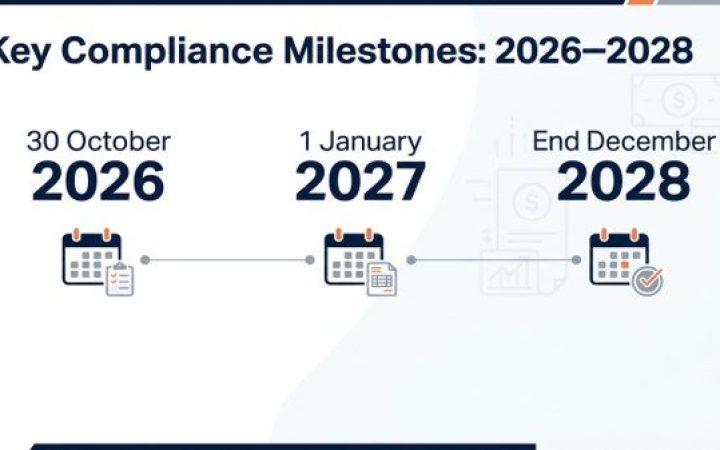
Alongside bilateral alignment, UAE regulatory guidelines detail the implementation framework for the country's upcoming mandatory structured e-invoicing system. Under Ministerial Resolution No. 66 of 2026, which amends Ministerial Decision No. 244 of 2025, the UAE Ministry of Finance extended the deadline for businesses with annual turnover of AED 50 million or more to appoint an Accredited Service Provider (ASP) from 31 July to 30 October 2026.
The mandatory e-invoicing rollout for companies with annual revenue of at least AED 50 million remains fixed for 1 January 2027, following a voluntary pilot phase that commenced on 1 July 2026. Businesses with annual revenue below AED 50 million and government entities must appoint an ASP by 31 March 2027, with mandatory implementation starting on 1 July 2027 and 1 October 2027, respectively.
The UAE e-invoicing regime uses a decentralized five-corner exchange model operating over the Peppol network, using the PINT AE data specification. The mandate applies to business-to-business (B2B) and business-to-government (B2G) transactions, while business-to-consumer (B2C) sales remain excluded pending future ministerial decisions. Temporary exemptions include international air cargo for 24 months, while sovereign government activities and international passenger tickets with e-tickets are also excluded.
Under the framework, Accredited Service Providers validate structured invoices and report required tax data to the Federal Tax Authority (FTA) without requiring advance invoice pre-clearance. The mandate applies generally to entities conducting business in the UAE regardless of VAT registration status, while existing VAT return filing rules and five-year document retention requirements remain in force.
Sources
- UAE-China Chamber of Commerce (UECN) · 2026-10-22