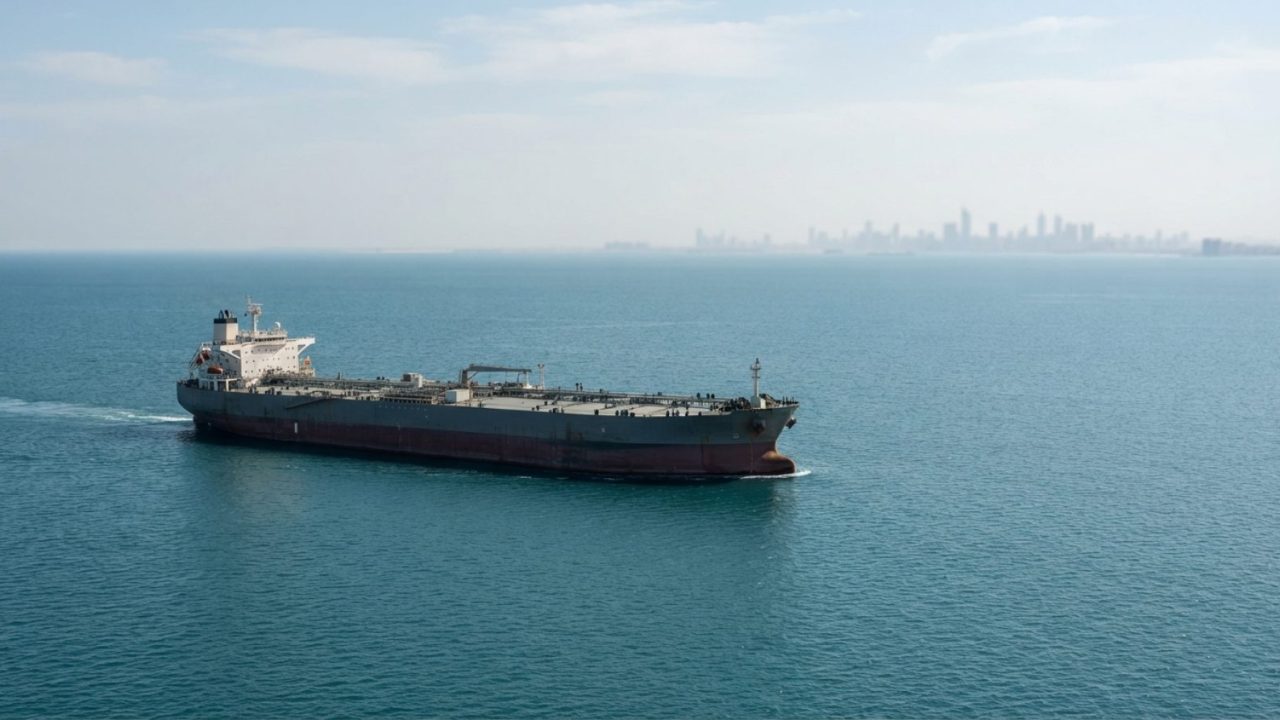
According to vessel tracking data from Signal Ocean, the supply of Very Large Crude Carriers (VLCCs) operating on the Arabian Gulf to China route averaged 93.2 vessels between 1 and 22 November 2026. This represented a 13.2 percent increase compared to the full-month October average of 82.3 vessels and an 8.8 percent increase compared to the same period in 2025. Spot and relet vessel availability expanded by 23.4 percent to reach an average of 61.5 vessels.
Despite the increase in available shipping capacity, crude liftings from Arabian Gulf terminals to China held steady. Loadings averaged 5.8 cargoes per day across 127 recorded shipments between 1 and 22 November, equivalent to approximately 11.1 million barrels per day. While matching the loading pace recorded from 1 to 22 October, daily liftings were 25 percent lower than during the corresponding period in 2025. In comparison, shipments from the US Gulf to China totaled seven cargoes over the same period, averaging 0.3 cargoes per day.
Benchmark freight earnings on the Middle East Gulf to China TD3C route averaged roughly $1.07 million per day during week 47, marking a 4.7 percent decrease week-on-week. TD3C earnings remained substantially above the US Gulf to China TD22 route, which averaged $246,000 per day. Suezmax and Aframax rates on Gulf loading routes also softened, with TD23 falling to $619,000 per day and TD8 easing to $320,000 per day.
Regional maritime security risks continue to affect operational conditions. The Joint Maritime Information Center maintained a severe regional maritime threat assessment on 18 November, while diplomatic discussions involving Qatar, the United States, and Iran regarding transit through the Strait of Hormuz remained unresolved as of 24 November.
Sources
- UECN · 2026-11-27