- Affected country
- Regional
- Location / route
- Airports across the Middle East, including UAE, Iraq, and Oman
- Official source
- Google News — Middle East travel disruption
- Published by source
- September 25, 2026 7:10 AM CST
- Effective period
- September 23, 2026 12:00 AM CST
- Last verified
- September 30, 2026 10:40 PM CST
- Status
- Resolved
Official guidance
Flydubai flight FZ1073 safely diverted to Tabuk, Saudi Arabia following a cockpit incident; passengers remain safe awaiting replacement transit.
Summary of official information. Always check the official source and follow the guidance of the authorities. UECN does not issue risk ratings; the absence of an alert does not mean that a destination is safe.

Update — September 30, 2026 10:40 PM CST: A Flydubai flight from Dubai to Tel Aviv made an emergency diversion to Tabuk, Saudi Arabia, on September 30, 2026, after transmitting emergency transponder codes. Israeli fighter jets were scrambled in response to a suspected hijack signal before authorities confirmed the alert was triggered by a physical fight between the two pilots. All passengers landed safely, and the airline made arrangements for a replacement aircraft.
Update — September 30, 2026 10:40 PM CST: A flydubai flight from Dubai to Tel Aviv made an emergency diversion to Tabuk, Saudi Arabia, following a violent cockpit altercation in which a pilot was stabbed. Flight tracking data showed the aircraft descended more than 17,000 feet in under two minutes before passengers and crew restrained the attacker. Saudi authorities arrested the suspect pilot, and the carrier dispatched a replacement plane for stranded passengers.
Update — September 30, 2026 10:39 PM CST: The European Union Aviation Safety Agency has extended its Conflict Zone Information Bulletin for Gulf airspace until November 16, 2026. The advisory instructs operators to avoid overwater operations across the Persian Gulf and parts of the Gulf of Oman, except for necessary arrivals and departures. Airlines operating over land territory within the affected flight information regions are urged to exercise heightened caution.
Update — September 30, 2026 10:38 PM CST: A flydubai commercial flight from Dubai to Tel Aviv made an emergency landing in Saudi Arabia on Wednesday following a mid-air flight deck altercation. Israeli officials stated that a pilot attempted to hijack the aircraft, while other crew members and passengers intervened to subdue him. Flydubai confirmed that the aircraft was secured, all passengers are safe, and a formal investigation is underway.
Update — September 29, 2026 9:38 AM CST: Multiple countries and Middle East jurisdictions have introduced entry curbs and visa suspensions to contain the spread of Ebola. In the UAE, new visa issuance for nationals of the DRC, Uganda, and South Sudan has been suspended, alongside transit entry limits. Bahrain and Qatar have also enacted entry bans and quarantine mandates for travelers arriving from affected nations.
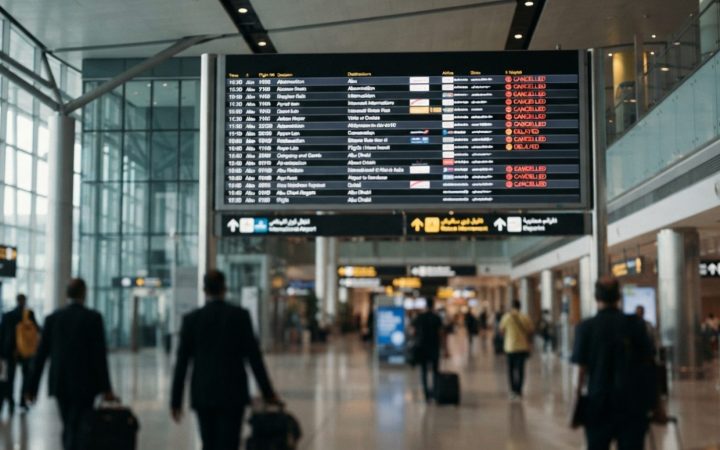
Update — September 28, 2026 9:10 AM CST: Airline shares dropped globally after conflict in Iran forced the closure of key Middle East transit hubs including Dubai and Doha. The disruptions caused thousands of flight cancellations and stranded tens of thousands of international travellers. Carrier valuations were further impacted by a seven percent surge in crude oil prices.
Update — September 28, 2026 9:10 AM CST: Airline shares declined globally as escalating conflict disrupted air travel and triggered higher oil prices. Major transit hubs including Dubai and Doha remained closed, stranding passengers and forcing carriers to cancel routes. Aviation data provider VariFlight reported that mainland Chinese carriers cancelled 26.5% of Middle East flights.
Update — September 27, 2026 9:09 PM CST: Middle East airspace restrictions are redirecting international overflights and diversions through Egyptian airspace. Aviation monitoring groups confirm that primary Europe-Asia bypass routes now run via Egypt, Saudi Arabia, and Oman or the UAE. However, reports indicate that heightened overflight traffic has not resulted in a wholesale transfer of connecting passengers from Gulf hubs to Cairo.
Update — September 27, 2026 8:40 AM CST: Senior Iranian officials have warned that regional airspace and flights could face widespread disruption following new US secondary sanctions targeting Iranian aviation. The warning follows Iran's suspension of all flights to the UAE and cancellations on several regional routes. Airlines and transit passengers face heightened risks of sudden schedule disruptions across Middle East corridors.
Update — September 27, 2026 8:40 AM CST: Mohammad Mokhber, a senior adviser to Iran's supreme leader, warned that Middle East air travel could face severe disruption if Iranian carriers remain barred from regional airspace and airport facilities. The statement follows moves by multiple regional countries, including Iraq and the United Arab Emirates, to suspend flights and services for Iranian airlines amid secondary sanctions warnings from the United States. The development raises the risk of retaliatory airspace restrictions and widespread commercial flight rerouting across key regional transit routes.
Update — September 26, 2026 8:38 PM CST: Iran has issued warnings to neighboring countries against complying with new U.S. sanctions targeting Iranian airlines. The secondary sanctions threat has triggered flight suspensions and disruptions in the UAE, Iraq, Oman, Georgia, and Azerbaijan.
Update — September 26, 2026 8:10 AM CST: UAE equity markets declined after a renewed airspace safety warning covering the Gulf raised concerns over regional aviation and tourism earnings. The European Union Aviation Safety Agency extended its conflict-zone bulletin for UAE and regional airspace, advising flight operators to assess operational risks. Local carriers have largely restored networks but continue facing intermittent delays and rerouting challenges.
Update — September 25, 2026 8:24 PM CST: U.S. diplomatic missions across the Middle East have issued security alerts advising travelers to prepare for possible flight cancellations and periodic airspace closures. The advisories cover ten countries and territories, urging travelers to monitor local developments and check schedules directly with airlines.
Update — September 25, 2026 8:19 PM CST: United States embassies across at least ten Middle East countries have issued coordinated security notices warning of potential flight cancellations, airspace closures, and travel disruptions. The notices advise travelers to exercise heightened vigilance and verify departure details directly with airlines and airport authorities. The warnings cover nations including the UAE, Saudi Arabia, Qatar, Bahrain, Kuwait, Oman, Jordan, Lebanon, Iraq, and Israel.
Update — September 25, 2026 8:19 PM CST: United States embassies across ten Middle Eastern countries have issued coordinated security alerts advising travelers of potential short-notice flight cancellations and airspace closures. The notices cover nations including the UAE, Saudi Arabia, Qatar, and Israel amid regional tensions. Travelers are advised to verify flight status directly with airlines and register with diplomatic missions.
Update — September 25, 2026 8:15 PM CST: The United States government has issued a worldwide security alert urging Americans to reconsider nonessential travel to and through the broader Middle East region. The alert cites an evolving security environment tied to friction involving Iran and aligned groups, alongside risks of sudden aviation disruptions. Travelers already in the region are advised to maintain heightened vigilance and prepare for flight cancellations and airspace closures.
Update — September 25, 2026 8:11 PM CST: Iranian officials have warned that regional airports cooperating with US measures to restrict Iranian airlines could face operational disruption. The warning follows the enforcement of US secondary sanctions targeting services to Iranian carriers, prompting multiple regional hubs to halt or restrict Iranian flights. Routes connecting China and Iran have remained operational, with Beijing publicly opposing the unilateral US measures.
Mohsen Rezaei, secretary of Iran's Supreme National Security Council, warned neighboring states during a broadcast on Iranian state television that their airports would be unable to operate if they cooperate with U.S. efforts to halt Iranian flights. Rezaei urged regional governments not to participate in the American measures, though he did not specify how Tehran would enforce disruptions against non-compliant airports.
The warning follows an announcement by U.S. Treasury Secretary Scott Bessent that Washington would impose secondary sanctions on aviation service providers—including airports, fueling companies, and ticketing agents—that support Iranian carriers. The measures seek to isolate Iranian commercial airlines from the international aviation network.
Regional flight schedules have experienced immediate operational fallout. The Iranian Students' News Agency reported that commercial flights between Iran and the United Arab Emirates were cancelled, while authorities in Azerbaijan and Georgia also suspended services. In Iraq, airports in Baghdad, Najaf, Erbil, and Sulaymaniyah halted flights to and from Iran, and scheduled services between Tehran and Muscat were withdrawn.
Despite the widening restrictions, some scheduled connections between Iran and international partners, including China and Turkey, have remained active, though carriers have faced service curtailments and lost ground-handling access in several regional transit hubs.
Revision history
- Resolved Official update applied: A Flydubai flight from Dubai to Tel Aviv made an emergency diversion to Tabuk, Saudi Arabia, on September…
- Updated Official update applied: A flydubai flight from Dubai to Tel Aviv made an emergency diversion to Tabuk, Saudi Arabia, following a…
- Updated Official update applied: European aviation authorities have extended conflict zone warnings across Gulf airspace as heightened tensions between the United States…
- Updated Official update applied: The European Union Aviation Safety Agency has extended its Conflict Zone Information Bulletin for Gulf airspace until November…
- Updated Official update applied: A flydubai commercial flight from Dubai to Tel Aviv made an emergency landing in Saudi Arabia on Wednesday…
- Updated Official update applied: Multiple countries and Middle East jurisdictions have introduced entry curbs and visa suspensions to contain the spread of…
- Updated Official update applied: Airline shares dropped globally after conflict in Iran forced the closure of key Middle East transit hubs including…
- Updated Official update applied: Airline shares declined globally as escalating conflict disrupted air travel and triggered higher oil prices. Major transit hubs…
- Updated Official update applied: Middle East airspace restrictions are redirecting international overflights and diversions through Egyptian airspace. Aviation monitoring groups confirm that…
- Updated Official update applied: Senior Iranian officials have warned that regional airspace and flights could face widespread disruption following new US secondary…
- Updated Official update applied: Mohammad Mokhber, a senior adviser to Iran's supreme leader, warned that Middle East air travel could face severe…
- Updated Official update applied: Iran has issued warnings to neighboring countries against complying with new U.S. sanctions targeting Iranian airlines. The secondary…
- Updated Official update applied: UAE equity markets declined after a renewed airspace safety warning covering the Gulf raised concerns over regional aviation…
- Updated Official update applied: U.S. diplomatic missions across the Middle East have issued security alerts advising travelers to prepare for possible flight…
- Updated Official update applied: United States embassies across at least ten Middle East countries have issued coordinated security notices warning of potential…
- Updated Official update applied: United States embassies across ten Middle Eastern countries have issued coordinated security alerts advising travelers of potential short-notice…
- Updated Official update applied: The United States government has issued a worldwide security alert urging Americans to reconsider nonessential travel to and…
- Updated Official update applied: Iranian officials have warned that regional airports cooperating with US measures to restrict Iranian airlines could face operational…
- Active Published automatically from the official source
Sources
- ИФЗ РАН · 2026-09-24
- Google News — Middle East travel disruption · 2026-09-30
- Google News — Middle East travel disruption · 2026-09-30
- Google News — Middle East travel disruption · 2026-10-05