According to the International Energy Agency's (IEA) Renewables 2026 report, the United Arab Emirates is projected to become the world's largest generator of solar photovoltaic (PV) electricity per capita by 2031, surpassing Australia as its clean energy buildout accelerates. The IEA forecasts that the UAE's solar PV output will exceed 4,000 kilowatt-hours (kWh) per person by 2031, up from approximately 1,500 kWh per person in 2025.
The per capita forecast measures annual solar power generation relative to population rather than total volume, where larger nations such as China generate significantly greater absolute amounts of electricity. Australia is projected to reach approximately 3,600 kWh per person by 2031, followed by Oman at 3,300 kWh, Bulgaria at 2,750 kWh, and Qatar at 2,700 kWh. Greece, Austria, Spain, China, and Chile are also expected to place among the top 10 countries, while the projected global average stands at about 800 kWh per person.
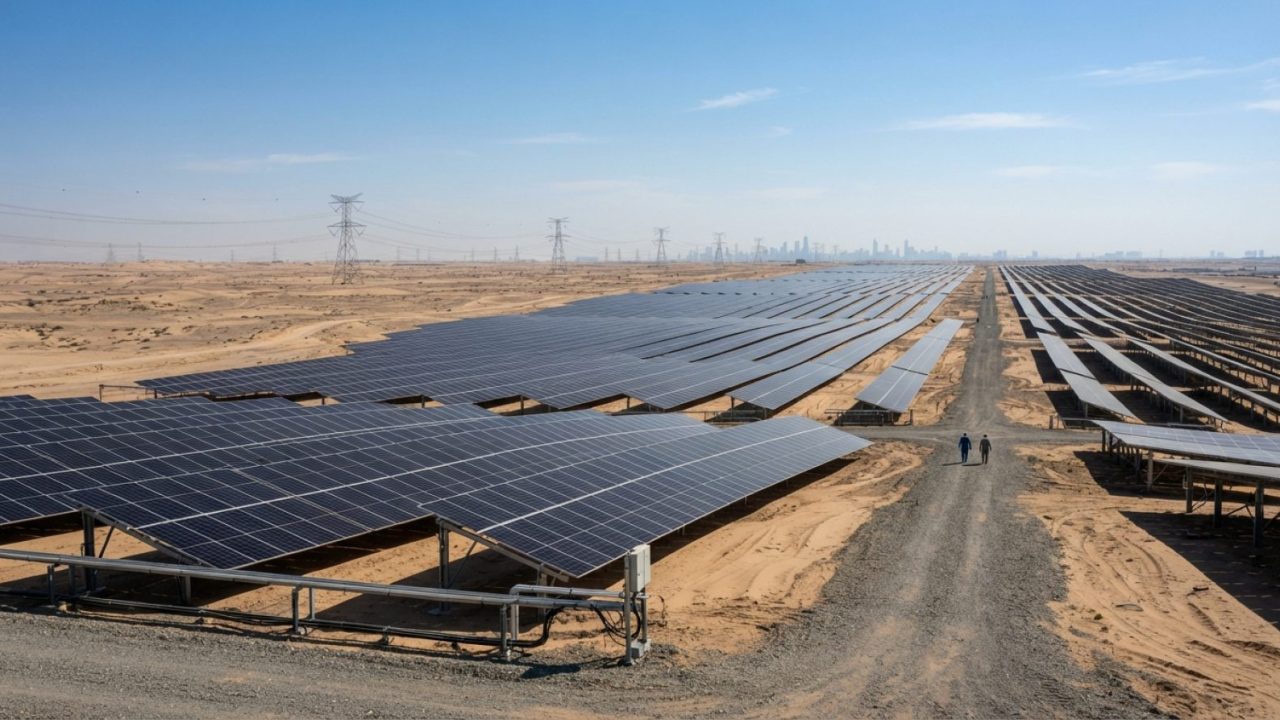
The UAE's trajectory follows revised government targets and rapid capacity additions. In January 2026, the UAE raised its target to supply 35% of total energy demand from clean sources—encompassing renewables and nuclear power—by 2031, up from an earlier target of 32% by 2030. Dubai's Mohammed bin Rashid Al Maktoum Solar Park, developed by the Dubai Electricity and Water Authority (DEWA), serves as a cornerstone of this buildout, currently operating at about 3,860 megawatts (MW) with an expanded development target of more than 8,000 MW by 2030.
Globally, renewable generation capacity is projected to expand by more than 4,770 gigawatts between 2026 and 2031, with solar PV accounting for roughly three-quarters of that growth. The IEA noted that the UAE's primary operational focus will center on integrating variable solar power into the national grid through investments in storage, transmission infrastructure, and flexible power systems.
Sources
- https://internationalfinance.com/ · 2026-11-13