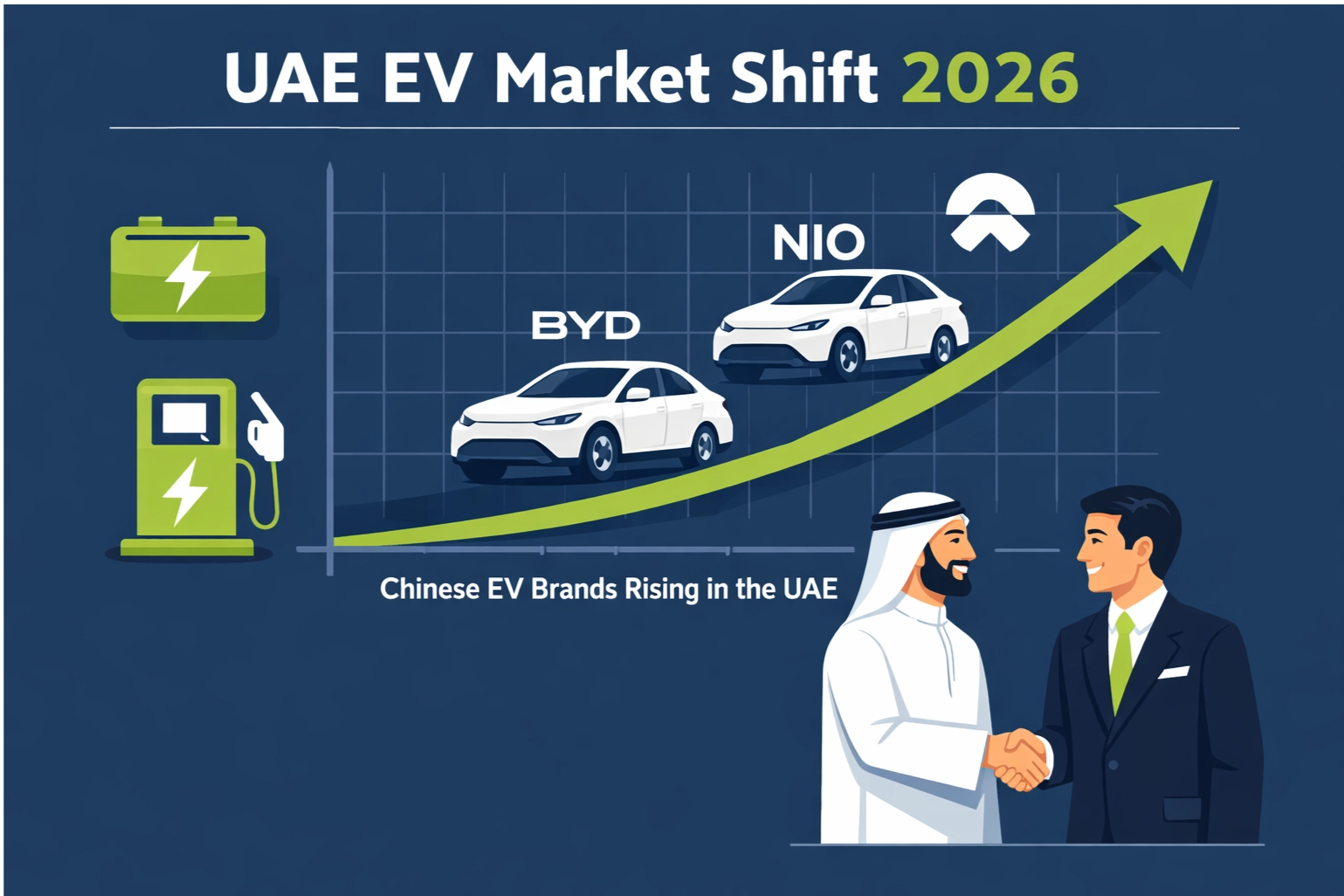
Chinese Electric Vehicles Storm UAE Market in 2026: Opportunities for Dealerships, Service Centers, and Infrastructure
BYD overtook Tesla as the world’s largest seller of electric vehicles in early 2026, symbolizing China’s dominance in the global EV market. With multiple Chinese EV brands launching in the UAE throughout 2026—including BYD, Zeekr, NIO, Denza, and Omoda—the Emirates is becoming a key market for Chinese automotive expansion. This creates significant opportunities for UAE businesses across the automotive value chain.
The Chinese EV Invasion: By the Numbers
Global Context
BYD’s Rise: In January 2026, The New York Times reported that BYD Auto overtook Tesla as the world’s largest seller of electric vehicles, marking a historic shift in the global automotive industry.
China’s EV Leadership: Chinese brands accounted for 60% of global EV battery market share in 2023, and EV/battery production represented approximately 39% of China’s clean energy investment in 2024.
UAE Market Dynamics
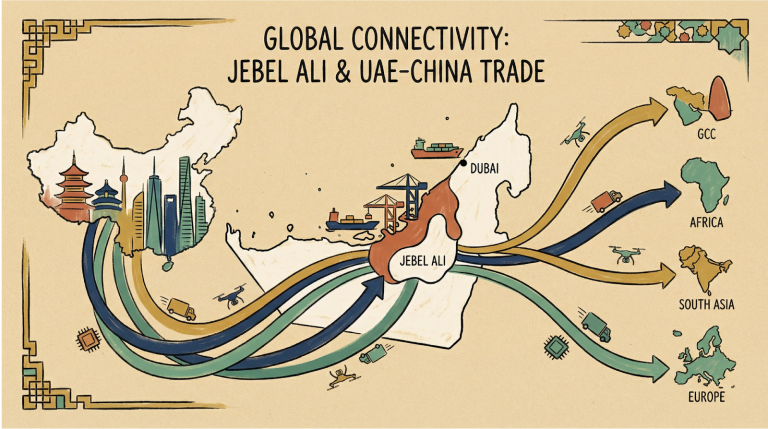
Jebel Ali Port Statistics (2024):
- Handled over 960,000 vehicles
- China is the largest automotive trade partner
- Significant year-on-year growth in Chinese vehicle imports
Market Growth: UAE automotive market is projected to grow substantially as Chinese brands offer competitive pricing, advanced technology, and comprehensive features.
Chinese EV Brands Entering UAE in 2026
1. BYD (Build Your Dreams)
Models Expected:
- BYD Atto 3: Compact SUV, 420 km range, AED 105,000-125,000
- BYD Seal: Sedan competitor to Tesla Model 3
- BYD Dolphin: Compact hatchback
- BYD Tang: 7-seater SUV
Strengths: Proven track record, competitive pricing, blade battery technology with heat tolerance, extensive warranty (8 years on battery).
2. NIO
Models Expected:
- ES8: Flagship SUV, 460-635 km range
- ET5: Sedan with battery swapping
- EC6: Coupe SUV
Unique Feature: Battery swapping technology—replace depleted battery in 3-5 minutes instead of charging.
Price Range: AED 182,000-370,000+
3. Zeekr (Geely’s Premium Brand)
Models Expected:
- Zeekr 001: Luxury shooting brake, 952 hp, 630 km range
- Zeekr X: Compact premium SUV
Strengths: High performance, luxury amenities, unique design.
Price Range: AED 300,000+
4. Denza (BYD-Mercedes Joint Venture)
Models Expected:
- Denza D9: PHEV 7-seater SUV, 745-mile total range, 56 miles electric-only
- Combines luxury with hybrid flexibility
Price Range: AED 115,000-140,000
Target: Families wanting range flexibility without full-electric anxiety.
5. Omoda (Chery Brand)
Models Expected:
- Omoda E5: Compact electric SUV
- Omoda C5: Hybrid variant
Strengths: Affordable entry point, suitable for first-time EV buyers.
Business Opportunities Across the Value Chain
1. Dealership Networks
Opportunity: Chinese brands seek local partners for sales and distribution.
Requirements:
- Showroom space in prime locations
- Service facilities
- Working capital for inventory
- Sales and technical staff
Revenue Streams:
- Vehicle sales margins
- Finance and insurance commissions
- After-sales service
- Parts and accessories
Action Steps:
- Contact Chinese manufacturers directly or through regional distributors
- Prepare business proposals highlighting UAE market knowledge
- Secure suitable showroom locations
- Develop financial projections
2. After-Sales Service Centers
Opportunity: Chinese brands need extensive service networks to build consumer confidence.
Services:
- Routine maintenance
- Warranty repairs
- Software updates
- Battery health checks
- Collision repair
Differentiators:
- Certified technicians
- Original parts availability
- Quick turnaround times
- Customer service excellence
Investment Requirements:
- Service bay equipment
- Diagnostic tools
- Technician training and certification
- Parts inventory
3. EV Charging Infrastructure
Opportunity: Mass EV adoption requires extensive charging networks.
Business Models:
- Public charging stations (malls, hotels, offices)
- Highway fast-charging corridors
- Residential charging solutions
- Fleet charging depots
- Battery swapping stations (for NIO partnership)
Revenue Streams:
- Per-kWh charging fees
- Subscription plans
- Advertising on charging stations
- Data services
Partners:
- DEWA and other utilities
- Real estate developers
- Municipalities
- Chinese charging network operators (like NIO’s Power Swap)
4. Parts and Accessories
Opportunity: Growing EV fleet needs consumables, accessories, and aftermarket parts.
Products:
- Replacement parts (brake pads, tires, filters)
- Accessories (floor mats, seat covers, sunshades)
- Charging cables and adapters
- Performance upgrades
- Cosmetic enhancements
Distribution Strategy:
- Wholesale to service centers
- Direct-to-consumer e-commerce
- Retail outlets
5. Insurance Products
Opportunity: EV-specific insurance products are underdeveloped.
Product Development:
- Battery degradation coverage
- Charging equipment protection
- Specialized collision coverage (high-voltage systems)
- Usage-based insurance leveraging vehicle data
- Cyber security coverage
Target: Partner with insurance companies to develop EV-specific products.
6. Fleet Management
Opportunity: Corporate and government fleets transitioning to EVs need management services.
Services:
- Fleet acquisition consulting
- Charging infrastructure planning
- Maintenance scheduling
- Driver training
- Total cost of ownership analysis
- Sustainability reporting
Target Clients:
- Government ministries and agencies
- Taxi and ride-hailing companies
- Delivery and logistics companies
- Corporate fleets
7. Battery Recycling and Second-Life Applications
Opportunity: EV batteries have value even after vehicle life ends.
Services:
- Battery collection and logistics
- Testing and grading
- Refurbishment for second-life applications (grid storage, backup power)
- Recycling for materials recovery
Partnerships: Work with Chinese battery manufacturers and recycling companies.
8. Training and Education
Opportunity: Growing need for EV-trained professionals.
Programs:
- Technician certification courses
- Sales training for dealership staff
- Driver education on EV operation and charging
- Safety training for first responders
Delivery: Partner with Chinese manufacturers or technical colleges.
9. Financing Solutions
Opportunity: Consumers need affordable financing for EV purchases.
Products:
- Retail auto loans
- Lease programs
- Battery-as-a-service financing (separate vehicle and battery ownership)
- Green financing with preferential rates
Target: Partner with banks or establish auto finance company.
10. Digital Platforms
Opportunity: Connect EV ecosystem participants.
Platform Ideas:
- EV marketplace (new and used)
- Charging station finder app
- Service booking platform
- EV ownership community
- Battery health monitoring service
Challenges and Mitigation Strategies
Challenge 1: Consumer Skepticism
Many UAE consumers are unfamiliar with Chinese EV brands.
Mitigation:
- Extended test drive programs
- Strong warranty offerings
- Build service network before mass sales
- Customer testimonials and reviews
- Educational marketing campaigns
Challenge 2: Charging Infrastructure Gaps
Insufficient public charging creates range anxiety.
Mitigation:
- Coordinate with government on public infrastructure
- Offer home charging solutions with vehicle purchase
- Partner with property developers for building charging
- Install destination chargers at key locations
Challenge 3: Summer Heat
Extreme UAE temperatures can stress battery systems.
Mitigation:
- Emphasize Chinese brands’ heat tolerance (like BYD’s blade battery)
- Offer extended cooling system warranties
- Educate consumers on optimal charging practices
- Provide covered parking at service centers
Challenge 4: Parts Availability
Limited local parts inventory can cause service delays.
Mitigation:
- Establish regional parts distribution center
- Maintain safety stock of fast-moving parts
- Negotiate air freight arrangements for urgent needs
- Develop relationships with Chinese suppliers
Challenge 5: Residual Value Uncertainty
Unknown resale values deter purchases.
Mitigation:
- Offer guaranteed buyback programs
- Develop used EV market and pricing data
- Battery health certification programs
- Lease programs that absorb residual value risk
Competitive Landscape
Established Players (Tesla, European Brands)
Advantages:
- Brand recognition
- Established service networks
- Proven track records
Chinese EV Strategy:
- Compete on price-to-feature ratio
- Offer superior technology in some areas (battery swapping, PHEV range)
- Provide more comprehensive warranties
- Faster service expansion
Japanese and Korean Brands
Situation: Traditional manufacturers slower to transition to EVs.
Opportunity: Chinese EVs can capture market share before traditional brands scale EV production.
Government Support and Incentives
UAE government initiatives supporting EV adoption:
Federal Level:
- Green mobility strategies
- Reduced registration fees for EVs
- Free parking in some areas
- Exemptions from Salik tolls (Dubai)
Dubai:
- EV Green Charger Initiative
- Smart Dubai EV infrastructure plans
Abu Dhabi:
- EV charging network expansion
- Incentives for EV adoption
Strategy: Stay engaged with government programs and position your business to benefit from incentives.
2026 Action Plan
Q1 2026 (Now)
- Market Research: Analyze which Chinese EV brands best fit UAE market
- Partner Outreach: Contact manufacturers expressing interest
- Competitive Analysis: Study successful models in other markets
- Financial Planning: Develop investment requirements and projections
Q2 2026
- Agreements: Sign dealer or service agreements
- Facility Development: Secure locations and begin buildout
- Staff Recruitment: Hire and begin training
- Supply Chain: Establish parts and inventory systems
Q3 2026
- Soft Launch: Begin operations with limited inventory
- Marketing: Launch awareness campaigns
- Infrastructure: Install initial charging stations if applicable
- Feedback: Gather early customer insights
Q4 2026
- Scale Up: Expand inventory and service capacity
- Performance Review: Assess first-year results
- Optimization: Refine operations based on experience
- 2027 Planning: Plan expansion for second year
Long-Term Outlook
2027-2030
Market Growth: Chinese EVs could capture 30-40% of UAE new vehicle market by 2030.
Infrastructure Maturity: Charging networks will approach petrol station ubiquity.
Technology Evolution: Next-generation batteries, autonomous features, vehicle-to-grid technology.
Used EV Market: Will develop robust secondary market.
Strategic Positioning
Businesses entering now establish:
- Brand recognition and trust
- Technical expertise and reputation
- Customer relationships
- Market share before competition intensifies
Conclusion
The arrival of multiple Chinese EV brands in the UAE in 2026 represents one of the most significant automotive market shifts in years. For UAE businesses, this creates a once-in-a-decade opportunity to establish leadership in an emerging segment.
The winners will be those who:
- Move quickly to secure partnerships
- Invest in infrastructure and capabilities
- Focus on customer experience and service quality
- Think ecosystem rather than just vehicle sales
Whether you’re an automotive dealer, service provider, tech company, or entrepreneur, the Chinese EV wave offers pathways to participation and profit.
The question is not whether Chinese EVs will succeed in the UAE—BYD’s global leadership and China’s manufacturing dominance make success inevitable. The question is whether your business will be part of this success story.
2026 is the year to decide and act.