China-GCC Free Trade Agreement: Breaking the Two-Decade Impasse in 2026

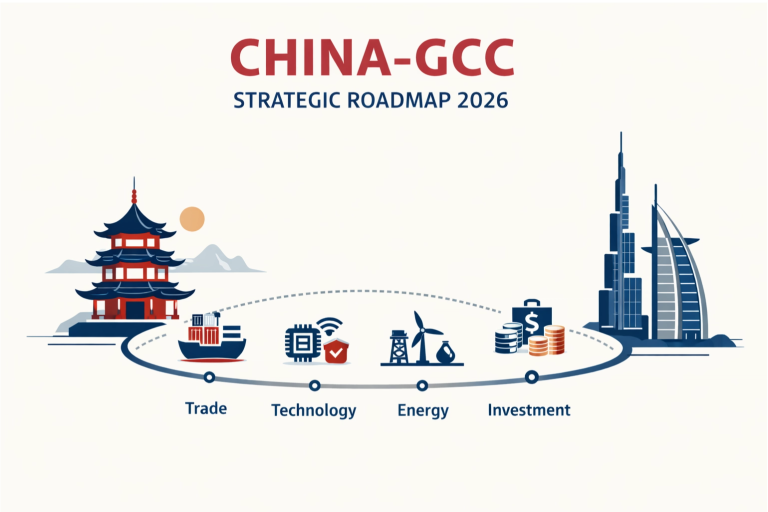
After more than two decades of negotiations, the China-GCC Free Trade Agreement stands at a critical juncture. With China set to host the second China-Arab States Summit and the second China-GCC Summit in 2026, there is renewed momentum to finalize this long-stalled agreement. For UAE businesses, understanding the dynamics, opportunities, and challenges of this potential deal is essential for strategic planning.
The State of Play in Early 2026
During Chinese Foreign Minister Wang Yi’s December 2025 visit to the UAE, both sides reaffirmed their commitment to “promote the early conclusion of negotiations on the China-GCC Free Trade Agreement.” The UAE voiced strong support for China in hosting both summits concurrently in 2026, expressing willingness to ensure their complete success.
This commitment comes against the backdrop of unprecedented trade growth. Non-oil trade between China and the UAE reached over $90 billion in 2024 and is expected to exceed $100 billion in 2026, according to UAE Foreign Trade Minister Thani bin Ahmed Al Zeyoudi. Overall bilateral trade between China and the GCC hit $101.8 billion in 2024—an 800-fold increase since diplomatic relations were established in 1984.
Why the 22-Year Delay?
Negotiations for the China-GCC FTA began in July 2004, when China was the bloc’s third-largest trading partner. Since then, the deal has come tantalizingly close to completion multiple times, only to stall. The key obstacles include:
1. Competing Industrial Interests
China and the GCC compete in several areas including petrochemicals, cement, aluminum, and steel. Less stringent trade barriers pose a threat to domestic industries on both sides. The negotiations were first suspended in 2009 after China refused to lift tariffs on GCC petrochemical exports to protect its domestic industry.
2. Economic Diversification Concerns
As Gulf states reduce their reliance on energy sales, protecting domestic industries has become critical to developing properly diverse economies. As U.S. tariffs tighten around the world, Gulf leaders have to weigh whether Chinese exports blocked elsewhere will be redirected into GCC markets, potentially undermining local companies and regional localization efforts.
3. External Disruptions
The 2017-2021 GCC diplomatic crisis, the COVID-19 pandemic, and disagreements over regional issues like Syria all contributed to delays. More recently, negotiations broke down in 2024 due to Saudi Arabia’s concerns that a flood of Chinese imports would undermine its industrial ambitions.
What’s Different in 2026?
Several factors make 2026 a potentially breakthrough year:
Strong Political Will
Wang Yi’s emphatic statement that China hopes the 2026 summits “will yield positive outcomes and elevate China-Arab states relations to a new level” reflects Beijing’s sense of urgency. The Chinese government’s explicit commitment to “complete the negotiations” during the summits signals high-level political backing.
Economic Imperative
With China facing trade tensions with the EU and tariff rates reaching 145% under recent U.S. administration policies, securing alternative markets has become critical. For the GCC, an FTA could provide an opportunity to emerge as alternative hubs for Chinese supply chains disrupted by American tariff policy.
Trade Momentum
Trade between China and Arab League members reached 1.72 trillion yuan ($241.6 billion) during the first seven months of 2025, setting a record for this period and rising 3.2 percent year-on-year. This momentum makes formalizing the relationship through an FTA economically logical.
Implications for UAE Businesses
Opportunities
Market Access: An FTA would reduce tariff barriers, making it easier for UAE companies to export non-oil goods to China, particularly in petrochemicals, aluminum, and re-export businesses.
Investment Flows: With over 15,000 Chinese firms already operating in the UAE, an FTA could accelerate bilateral investment. The UAE-China Joint Investment and Economic Cooperation Working Group, formed in May 2024, would have a stronger framework for collaboration.
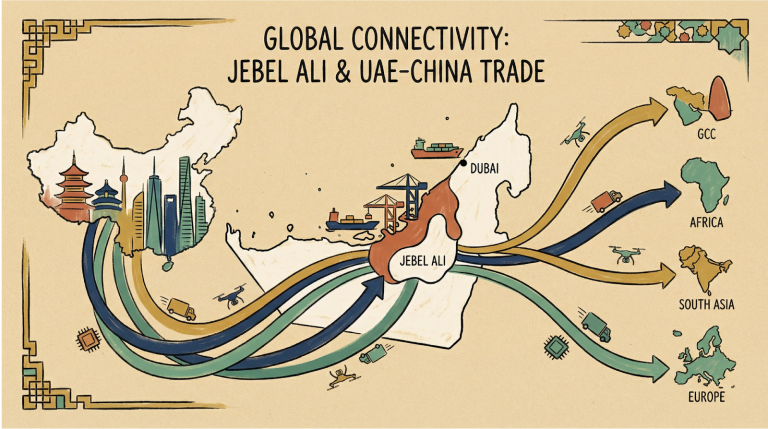
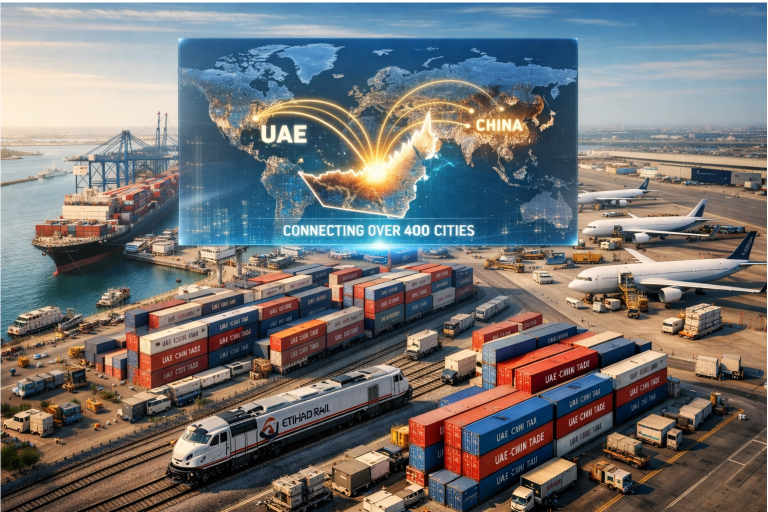
Regional Hub Status: The UAE’s role as a trading hub could be enhanced. More than 60 percent of Chinese exports shipped to the UAE are re-exported to over 400 cities. An FTA could solidify this position.
Sectoral Growth: Key sectors including renewable energy, technology, digital economy, logistics, and advanced manufacturing would see enhanced cooperation opportunities.
Challenges to Monitor
Anti-Dumping Concerns: The UAE implemented anti-dumping measures on Chinese goods in October 2025 to protect local industries. Balancing FTA benefits with domestic industrial protection will be crucial.
Sectoral Sensitivity: Certain industries may face heightened competition. UAE businesses should conduct sector-specific impact assessments.
Adaptation Period: Even if signed in 2026, implementation would be phased. Companies should prepare transition strategies.
Strategic Recommendations for UAE Businesses
1. Stay Informed
Monitor the summits closely. While official readouts may be general, specific mentions of sectoral protections or phased implementation timelines will signal real progress.
2. Conduct Impact Assessments
Evaluate how an FTA would affect your specific sector. Industries with strong Chinese competition should develop strategies to differentiate through quality, service, or specialization.
3. Explore Market Entry
Chinese companies may accelerate UAE market entry if an FTA appears imminent. Consider partnership opportunities or strategies to serve this growing business community.
4. Leverage Existing Frameworks
Don’t wait for the FTA. Utilize existing platforms like the UAE-China Business Council, free zone incentives, and bilateral agreements to build relationships and test market strategies.
5. Diversify Supply Chains
Whether the FTA materializes or not, diversification remains prudent. Explore opportunities in both Chinese and alternative markets.
The Verdict: Cautious Optimism
While 2026 presents the strongest opportunity in years for the China-GCC FTA, if calls remain one-sided and formulaic, meaningful progress is not likely. The real test will be whether official readouts from the summits include specific sectoral provisions rather than general commitments.
For UAE businesses, the message is clear: prepare for multiple scenarios. Position your business to capitalize on an FTA if it materializes, but don’t base your entire China strategy on its completion. The UAE-China relationship is strong and growing with or without an FTA—the agreement would simply formalize and accelerate trends already underway.
As the UAE continues to strengthen its position as China’s largest export market in the Middle East and China’s largest trading partner in West Asia and North Africa, the economic logic for deeper integration is undeniable. Whether 2026 becomes the year this two-decade journey reaches its conclusion remains to be seen, but one thing is certain: UAE businesses that understand the dynamics and prepare accordingly will be best positioned for success.